SUBSCRIBE TO ROTORY ROTORY BACK ISSUES DOWNLOAD THIS ISSUE TO YOUR COMPUTER


SEPTEMBER / PCTOBER - 2004


X-CELL'S TRICK TEMPEST


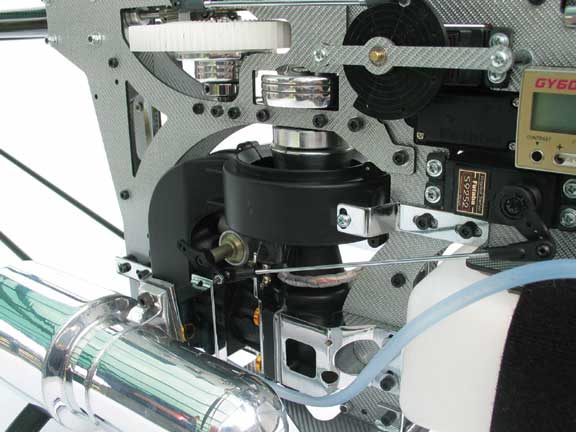
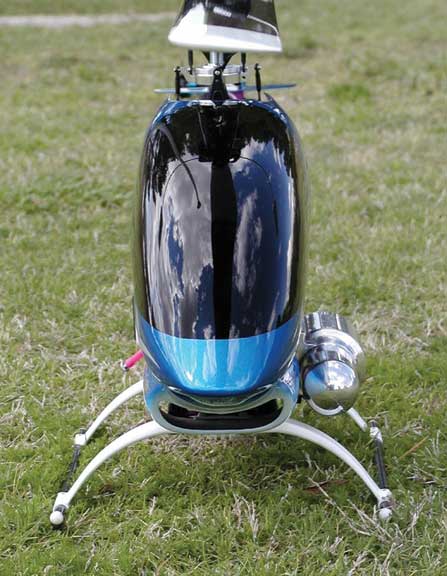
With the success of TV series like Choppers and Monster Garage, there's evidence that Americans not only like for their machines to perform good but they also like for them to look good. On that tone, I set out to make a heli that looked like those chopper motorcycles from the TV program. So, I purchased one of the first Tempest kits as soon as it hit the market. All of this happened just a few weeks away from the fall San Diego fun fly where I live and I wanted to take my blinged-out Tempest to the event. I needed some parts for my project so I drove to a hobby shop in Los Angeles. To my surprise, they had something I hadn't planned on, which was some gorgeous silver carbon fiber frames for the Fury Extreme by CarbonXtreme. The instant I saw them I realized that they would match great with all the chrome I was planning for my "Harley Tempest".
Nevertheless, I was quickly disheartened when I learned that they didn't have the silver frames for the Tempest in stock. I asked if they could get them, but there was just not enough time to order a set for me to be able to build it before the fun fly. Talking to a friend of mine, I found out that lucky for me the owner of CarbonXtreme happened to be a member of the club I fly at. I gave him a call, explaining what I wanted to do and they made me a set overnight. I had a friend that has a anodizing and chrome shop down here and I had him chrome all the metal parts for me. It took me a while to get the parts prepared for the chroming because I didn't want the chroming to modify precise inside diameters where bearings and other parts would fit. I think I made at least ten trips back and forth to the shop, taking more parts I could "bling out". This was a hard process - trying to chrome all the parts and not change any of the bearing clearances and tight fitting areas. I used different size tubing to seal the bearing chambers and used a micrometer to measure clearances before and after chroming. The process of chroming started with removing all the anodizing then polishing to a fine finish followed by nickel plating and finally chroming. I had a fear that with all the chrome the helicopter might end up looking tacky, but once I had all the parts put together, I was very pleased with the outcome. All the chrome was nice but I don't think that without the silver frames it would have looked half as good. The canopy paint job was done by a friend at APDesigns. The machine is powered by OS 91 C-Spec (updated later to a P/S version) with the OMI ViperHead dual plug and MP II. As for the electronics: I used four 9252 Futaba digital servos, GY 601 gyro, GV1 governor, and R149DP receiver.


FUTABA 7CHP SYSTEM

Almost on the heels of the release of the 9C system, Futaba has released yet, another " C" system called the 7C. While the 7C has less capability than the 9C, it still offers many advanced features to make it a serious contender for the sport or 3D heli pilot. As expected, the 7C has considerably more features than the older Super 7 system, but at less cost. The new 7C fills the void between the six-channel system and the popular 9C.
Visually the 7C has some of the cosmetics of the popular 9C heli system. Aside from its sophisticated software, one of the 7C's many "carry-over" features is the "Dial/Key," which allows the user to zoom through menu features by just turning and pushing one dial.
The 7C offers a 5-point throttle and pitch curve ­ gyro programming ­ hovering throttle and pitch knob (shared) ­ separate offset trims for each condition ­ switch assignability, and a delay function to smooth out gaps between idle-up's. The 7C is available in FM or PCM versions. The major difference between sets is the receiver, since the transmitter is capable of both emissions. Our set came in an FM configuration with a 1000 mAH airborne battery pack, switch, and 4 S3151 digital servos. Yes, I said digital. Finally, digital servos are now being offered even on low to mid priced systems.


R- 90 STANDARD


I have been flying for five years. I can manage nose-in maneuvers and aerobatic 101 stuff. My idols are pilots who compete in XFC and 3D Master competitions. I aspire to be like them one day. For learning 3D, I want a model with very affordable and readily available replacement parts. The Raptor 90 shares many of the same parts as the Raptor 60 and Raptor is the most popular helicopter sold in hobby shops and through mail order. I want a fast building and fast repairing helicopter since this is going to my primary 3-D learning tool. The Raptor 60/90 series has the least parts count. Many people have put a Raptor 60 or a 90 kit together in four hours. Me, I am slower, but I did a Raptor kit in six hours. If I am going to practice 3-D, accidents will happen and the next requirement is for the machine to be rugged and tough like a Hummer. I have never bent the 2 mm aluminum sideframes on the Raptor 60 from crashing. The R90 STD frames are even thicker than the 60; they are 2.5 mms. I do not want a trophy queen, I want a model for abuse and I do not want to buy a lot of upgrades. The Raptor 90 STD comes with a metal swashplate, metal washout hub, and metal tail pitch slider, which I feel are the three most critical items to satisfy my flying needs. All Raptor 60s and 90s come with a torque tube drive and a driven tail for doing aerobatic autos. At my present skill level, I do not need other fancier features. The new cooling shroud on the Raptor 90 accepts the YS 91 or TT 90 or even the tall heat sink on the OS 91 C-Spec engine. I have considered the Freya before but the Hirobo cooling shroud does not fit the OS 91 C-Spec engine. Some 90-class model kits require hack sawing the beautiful gold heat sink on the OS 91 C-Spec, and that makes me cringe. In addition, I do not feel like spending another $120 on a Viper head for the OS C-Spec so it can fit in the Freya or Fury. OS probably could have made the seat sink lower. The R90 STD was delayed in launching for a few months because, Thunder Tiger had to make a new molded cooling shroud and servo tray just to allow the OS 91 C-Spec to fit. This new cooling shroud and servo tray will also fit the old R60 frame, and the old cooling shroud and servo tray will fit the new R90. However, only the new shroud and tray will fit over the OS 91 C-Spec..


XFC COMPETITION


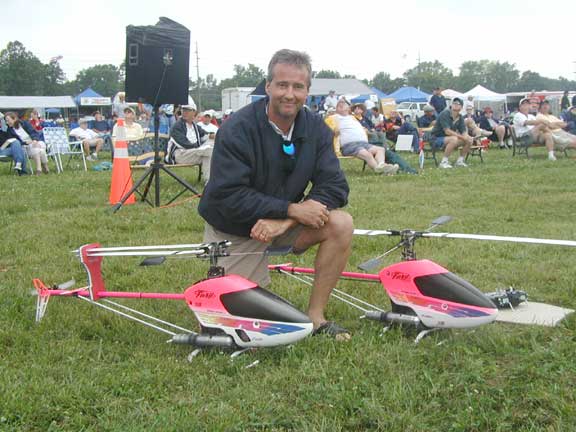
Welcome to the 3rd annual Extreme Flight Championships, an event designed to entertain spectators and dare the biggest names in R/C aviation! This invitation only contest held June 11th ­ 13th at the historic WACO Field in Troy Ohio features North America's top R/C helicopter and airplane pilots.
For 2004 the number of invitees was expanded, and the first two days of competition used to cull the field down to the top ten in each discipline. On the helicopter side invitations were extended to:
w Matt Botos - Atlanta, Georgia
w Mark Fadely - Indianapolis, Indiana
w Scott Gray - Kitchener, Ontario
w Anthony Jager - College Station, Texas
w Marcus Kim - South Carolina
w Marty Kuhns - San Pedro, California
w Eric Larson - Austell, Georgia
w Steven McFall - South Lyon, Michigan
w Justin Moore - Ft. Worth, Texas
w Peter Niotis - Grande Haven, Michigan
w Paul Soha - Stow, Ohio
w Jim Stark - Oak Brook, Illinois
w Jeff Swartz - New Middletown, Ohio
w Alan Szabo - Las Vegas, Nevada
w Mike Trueblood - Cincinnati, Ohio
w Curtis Youngblood - Austin, Texas
The competitors are broken down into groups by blind draw, and flying rounds are rotated between airplanes and helicopters every 6 flights to keep things interesting for the spectators. Each discipline, be it planes or helis, has there own team of judges.


SUBSCRIBE TO ROTORY ROTORY BACK ISSUES DOWNLOAD THIS ISSUE TO YOUR COMPUTER