SUBSCRIBE TO ROTORY ROTORY BACK ISSUES DOWNLOAD THIS ISSUE TO YOUR COMPUTER


NOVEMBER / DECEMBER 2004


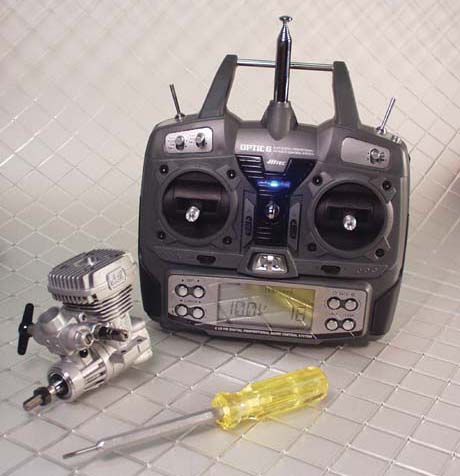
 Hitec's Optic 6

The Optic is Hitec's latest release in an economically priced system aimed at the new or sport pilot. The system is a versatile FM/QPCM radio control system in that it may be used for helicopters, as well as aircraft. The Optic system can store programming for eight different models. The transmitter will recall all of your settings for each of your different models. There is no chance of lost model memory, since no backup battery is ever needed. The system uses permanent e-prom memory to store information on a chip.
The Optic is equipped with electronic digital trims. Therefore, trims for each model and Idle-Up remain at the same position you left them when they are recalled. Another versatile feature is the Optic comes with a programmable shift feature, which allows the transmitter to operate most all PPM/FM receivers, even those from other brands!


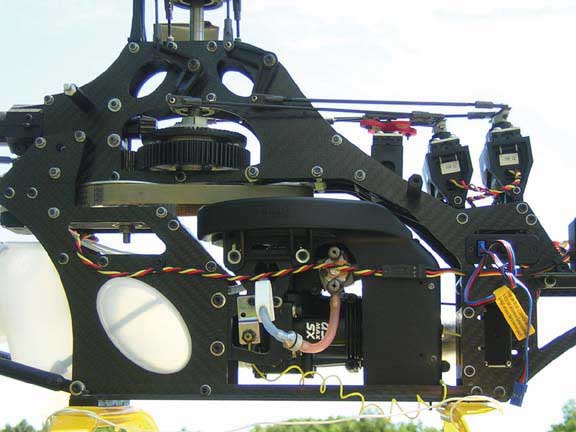
Hirobo Freya

In writing this, I hope to start a new trend in Rotory Modeler Magazine and maybe the hobby, as a whole. The traditional review is written shortly after a new kit's introduction and is really only a "first impression" of the machine dealing with initial quality, construction issues, and first flight impressions. This review will deal with different issues.
I've been flying my Freya for about a year now and am very familiar with just about every aspect of the machine. As such, in addition to touching on some of the construction features, I'll also be sharing my notes on how the machine holds up over time. Things like daily wear and tear, repair costs after a crash, and upgrades I've installed, or would like to see. Before I get into it though, I'd like to thank Mike Mas, Jeff Green of Altech Marketing and a few others for their patience while I completed this review. It ended up taking a lot longer than I'd anticipated but the information presented should be a lot more appropriate to potential buyers of the machine. Let's get started!


Robbe Cautro 90

In recent issues, we have examined many different 90-size helicopters, but all of them were converted from their 60-size siblings. The manufacturers extended the tail boom by a few centimeters and then allowed 710-720mm blades to be used instead of the 680-690mm blades employed on the 60 models. That is perfectly fine for a 3-D helicopter because the extra power-to-weight ratio dramatically improves 3-D performance. However, the engineers at Robbe Germany decided to take on a different challenge to achieve their 90-helicopter. Robbe's helicopter designer and manager, Mr. Wahl worked with a Dutch F3C pilot and set a goal to build a true 90-size helicopter that was just shy of a 1.8-meter main rotor diameter. They wanted their big helicopter for four missions: F3C competition, industrial and aerial photography work, as a scale platform, and 3-D flying. The new product is aptly named the Cuatro.


Wireless Telemetry Transmitter

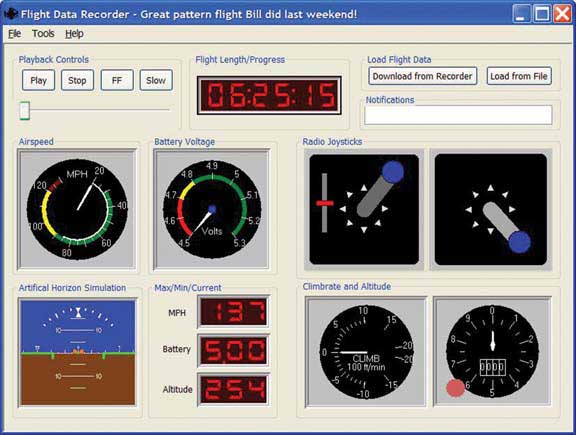
Have you every wondered what went on, "up there," while you were standing there on the ground, transmitter in hand? Wouldn't it be nice to be able to see every move your sometimes-nervous fingers made? How valuable would it be to you to know information like engine RPM, engine temperature, airspeed, battery voltage, and altitude while your model was actually flying?
Well, wonder no more, thanks to Eagle Tree systems. Eagle Tree Systems is owned by Bill and Marianne Parry and was created in late 2002. Both husband and wife, having technical backgrounds, decided to work together to create a technical means for finding a solution to a perplexing series of crashes with their own models. Necessity is the mother of invention ­ indeed! What Is It?
Personally, I was very interested in this product because of its very versatile nature. Since I enjoy flying both helicopters and airplanes, it seemed to me that this little device would be able to handle both kinds of machines very well. The Flight Data Recorder (FDR) is a small electronics package (see photos) that monitors and records both control inputs and various on-board systems. Here are the specifications and capabilities of the unit:


2nd Annual O.C. Bob Gathering

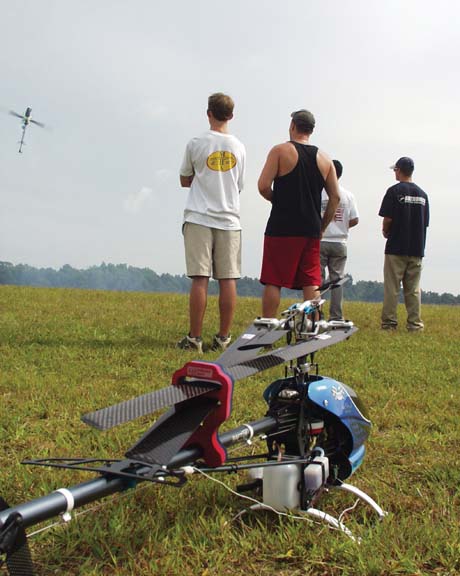
If you were lucky enough to attend the 2nd Annual O.C. Bob Gathering in Atlantic City, hosted by the Atlantic County Skyblazers RC Club, you'll know exactly what I mean. Unlike last year, where it was held on the back end of a hurricane that slammed the east coast, this year the weather was great - with temperatures in the low 80's and sunny. In contrast, during the event this year, the hurricane(s) stayed south and crossed the mid part of Florida.
For those of you who might not know O.C. Bob (Bob Pinto) it was none other than myself that gave him the title, which stands for "Out Of Control" Bob because of his disregard for a helicopter's "life," while flying! After a hiatus of about 20+ years, Bob got back into the hobby. Now, a few years later, he's even hosting his own Fun-Fly. You can catch Bob on the Rotory Forum at: www.rotory.com
Getting back to the event - unlike other Fun-Fly's, as each contestant arrived at the field, registration was a bit different. First item was; there was no entry fee. Yep, just come sign up and away you go. The second surprise was a free lunch was included for both pilots and guests alike. Three BBQ grills ran full-blast. Unlimited cheeseburgers and hot dogs with your choice of beverage were available.


TME ­ Battery Management

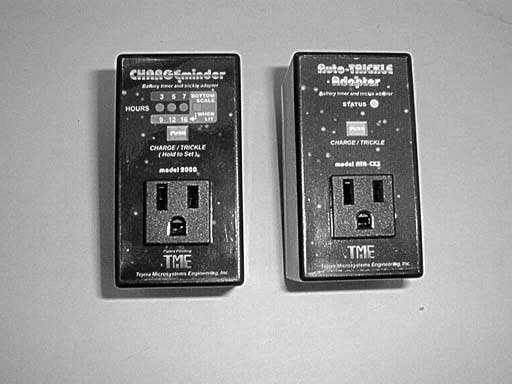
I'm sure that if in casual conversation, I were to mention the standard wall chargers that come with radio systems, I would receive many unflattering names for them. Wall Warts is one of my favorites. No one seems to like them since they are not "smart chargers" and if by chance one forgets and leaves them plugged in, there is a chance they will "fry" the battery packs.
In fact, these wall chargers are not sophisticated. Indeed, they perform only one task, and that is to supply low-voltage DC current to both the transmitter pack (9.6 volts) and receiver pack (4.8 volts) for charging purposes. They provide a charge rate at around 50ma, (C/10 ­ see below) and are designed to be plugged in for about 16 hours to fully charge battery packs.
The 16-hour charge time is determined from what is referred to as the "C" rate of charge or "C" table for charging nickel cadmium (NiCd or Ni-Cad) batteries. This "C" table is a theoretical table that calculates charge time for a battery based upon its capacity. The expression "mAh" or Milliamp Hours is used to define the expected capacity of a battery against time.
Here's How It Works:
The "C" in the table refers to the rated capacity of a battery in milliamp-hours or (mAh) and is used to define charging and discharging rates. C/10 rate refers to the number of milliamps (mA) you get when dividing C by 10. Or, in the case of a 500 mAh battery, 500/10 = 50 mA. That means that a 500 mAh battery is supposed to last 10 hours with a current draw of 50 mA. Put another way, that same 500-mAh battery theoretically will last 1 hour at a 500 mA draw (or load). Think of this formula . . .


Safety - Ignorance, Apathy, and Safety

Some of you may recall, last year a man named, Ron Kyle was killed when the helicopter he was flying hit him. It appears that the circumstances surrounding his death were an unfortunate accident during an instruction session with a student pilot, and the news of his death reached far-and-wide in the Internet community. Unfortunately, some trends that I've seen recently cause to wonder if people even remember the lessons learned from Ron's death.
A few weeks prior to writing this column, I attended a fun-fly in southwest Michigan. It was a decent showing, attended by some pilots of varying degrees of notoriety. Among the attendees was one of the top pilots on the American 3D circuit. It was quite a day, to be certain - lots of scale projects, a few manufacturers, some great food, and lots of spirited conversation. But, there were a few things that really caused my blood to run cold.


SUBSCRIBE TO ROTORY ROTORY BACK ISSUES DOWNLOAD THIS ISSUE TO YOUR COMPUTER